Numerical Optimization
Numpy implementation of Gradient Descent, Gradient Descent with Line Searches, Gradient Descent using Conjugate Gradients, Newton's Method.
Optimization Algorithms
import numpy as npfrom numpy import linalg as LAimport matplotlib.pyplot as pltimport torch as thfrom torch.autograd.functional import hessianF function below is multi modal function, non-convex because there are multiple optimal solutions. (Convex functions have just one optimal solution)
def f(x, y): return 2 * np.sum(np.log(LA.norm(x-y, axis=1)), axis=0)y = np.array([[1., 0.], [-1., 1.], [-1.5, -1.]])f([0,0], y)#y = y.reshape(1,3,2)1.8718021769015913
x_ = np.linspace(-2, 2, 300)y_ = np.linspace(-2, 2, 300)xx, yy = np.meshgrid(x_, y_)xy = np.array([xx.flatten(),yy.flatten()])zz = f(xy, y.reshape(3,2,1))_ = plt.contour(xx, yy, zz.reshape(xx.shape), levels=30)
def grad_f(x, y): return np.sum(2 * (x-y) / (LA.norm(x - y, axis=1).reshape(3,1))**2, axis=0)x = np.array([0.5, 1.5])y = np.array([[1., 0.], [-1., 1.], [-1.5, -1.]])grad_f(x, y)array([1.1902439 , 2.08780488])
Gradient Descent
Guess a solution $\vec x_0$
determine $$ \vec \triangle_0 = - \nabla f(\vec x_0) $$ update estimate $$ \vec x_1 = \vec x_0 + \eta \vec \triangle_0$$ repeat $$ \vec \triangle_t = - \nabla f(\vec x_t) $$ $$ \vec x_{t+1} = \vec x_t + \eta \vec \triangle_t$$
def grad_descent(x, y, lr=0.01): x_hist = np.array(x) for i in range(35): grad_x = grad_f(x, y) x = x - lr * grad_x x_hist = np.vstack((x_hist, x)) return x_hist lr = 0.05x = np.array([1, 1.5])y = np.array([[1., 0.], [-1., 1.], [-1.5, -1.]])x_hist = grad_descent(x, y, lr=lr)#print(x_hist)plt.contour(xx, yy, zz.reshape(xx.shape), levels=30)_ = plt.plot(x_hist[:,0],x_hist[:,1], "->")
Gradient Descent with Line Searches
Guess a solution $\vec x_0$
repeat $$ \vec \triangle_t = - \nabla f(\vec x_t) $$ $$ \eta_t = argmin_{\eta} \space f(\vec x_t + \eta \vec \triangle_t) $$ $$ \vec x_{t+1} = \vec x_t + \eta_t \vec \triangle_t$$
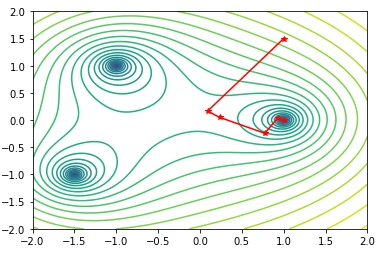
def grad_desc_line_search(x, y): x_hist = np.array(x) for i in range(100): change = -1 * grad_f(x, y) lr_list = np.linspace(0.,1,1000) min_value = f(x + lr_list[0] * change, y) min_lr = lr_list[0] for lr in lr_list: value = f(x + lr * change, y) if value < min_value: min_value = value min_lr = lr if min_lr!=0: x = x + min_lr * change x_hist = np.vstack((x_hist, x)) return x_histx = np.array([1, 1.5])y = np.array([[1., 0.], [-1., 1.], [-1.5, -1.]])x_hist2 = grad_desc_line_search(x, y)print(x_hist2[-1])print(x_hist2.shape)[ 0.99185658 -0.00607454] (5, 2)
plt.contour(xx, yy, zz.reshape(xx.shape), levels=30)_ = plt.plot(x_hist2[:,0], x_hist2[:,1], "-*r")
Gradient Descent Using Conjugate Gradients
Guess a solution $\vec x_0$ $$ \vec \triangle_0 = - \nabla f(\vec x_0) $$ $$ \vec c_0 = \vec \triangle_0 $$ $$ \eta_0 = argmin_{\eta} \space f(\vec x_0 + \eta \vec c_0) $$ $$ \vec x_1 = \vec x_0 + \eta_0 \vec c_0$$
repeat $$ \vec \triangle_t = - \nabla f(\vec x_t) $$ $$ \vec c_t = \vec \triangle_t + \beta_t \vec c_{t-1} $$ $$ \eta_t = argmin_{\eta} \space f(\vec x_t + \eta \vec c_t) $$ $$ \vec x_{t+1} = \vec x_t + \eta_t \vec c_t$$ For beta: the Fletcher-Reeves formula: $$ \beta_t = max \bigg \{ 0, \frac{\vec \triangle_t^T \vec \triangle_t}{\vec \triangle_{t-1}^T \vec \triangle_{t-1}} \bigg \}$$ the Polak-Ribière formula:
$$ \beta_t = max \bigg \{ 0, \frac{\vec \triangle_t^T (\vec \triangle_t - \vec \triangle_{t-1})}{\vec \triangle_{t-1}^T \vec \triangle_{t-1}} \bigg \}$$
def f(x, y): return 2 * np.sum(np.log(LA.norm(x-y, axis=1)), axis=0)def grad_f(x, y): return np.sum(2 * (x-y) / (LA.norm(x - y, axis=1).reshape(3,1))**2, axis=0)def min_lr_search(x, y, change): lr_list = np.linspace(0.,1,1000) min_value = f(x + lr_list[0] * change, y) min_lr = lr_list[0] for lr in lr_list: value = f(x + lr * change, y) if value < min_value: min_value = value min_lr = lr return min_lr"""For beta:Fletcher-Reeves formulabeta = np.max((0, (change[i].T @ change[i])/(change[i-1].T @ change[i-1])))Polak-Ribière formula beta = np.max((0, (change[i].T @ (change[i] - change[i-1])) / (change[i-1].T @ change[i-1]) ))"""def grad_desc_conj_grad(x, y): c = [] change = [] x_hist = np.array(x) change.append(-1 * grad_f(x, y)) c.append(change[0]) min_lr = min_lr_search(x, y, c[0]) x = x + min_lr * c[0] x_hist = np.vstack((x_hist, x)) for i in range(1,30): change.append(-1 * grad_f(x, y)) beta = np.max((0, (change[i].T @ (change[i] - change[i-1])) / (change[i-1].T @ change[i-1]) )) #PR #beta = np.max((0, (change[i].T @ change[i])/(change[i-1].T @ change[i-1]))) #FR c.append(change[i] + beta * c[i-1]) min_lr = min_lr_search(x, y, c[i]) if min_lr != 0: x = x + min_lr * c[i] x_hist = np.vstack((x_hist, x)) return x_histx = np.array([1, 1.5])y = np.array([[1., 0.], [-1., 1.], [-1.5, -1.]])x_hist2 = grad_desc_conj_grad(x, y)print("x_hist2.shape= ", x_hist2.shape)print(x_hist2[-1])x_hist2.shape= (6, 2) [ 1.0086712 -0.00769076]
plt.contour(xx, yy, zz.reshape(xx.shape), levels=30)_ = plt.plot(x_hist2[:,0], x_hist2[:,1], "-*r")
Gradient Descent Using Newton's Method
Guess a solution $\vec x_0$
repeat $$ \vec \triangle_t = - \nabla f(\vec x_t) $$ $$ \vec x_{t+1} = \vec x_t + \eta H^{-1} \vec \triangle_t $$
def f_th(x): y = th.tensor([[1., 0.], [-1., 1.], [-1.5, -1.]]) return 2 * th.sum(th.log(th.norm(x-y, dim=1)), dim=0)def grad_f(x): y = np.array([[1., 0.], [-1., 1.], [-1.5, -1.]]) return np.sum(2 * (x-y) / (LA.norm(x - y, axis=1).reshape(3,1))**2, axis=0)def newtons_method(x, lr): x_hist = np.array(x) for i in range(5): change = -1 * grad_f(x) hessian = th.autograd.functional.hessian(f_th, th.tensor(x)) x = x - lr * LA.inv(hessian.numpy()) @ change x_hist = np.vstack((x_hist, x)) return x_hist lr = 0.3x = np.array([1.,1.])x_hist = newtons_method(x, lr)x_hist[-1]array([1.06883485, 0.07265472])
plt.contour(xx, yy, zz.reshape(xx.shape), levels=30)_ = plt.plot(x_hist[:,0], x_hist[:,1], "-*r")
consider problem such as $$ argmin_{\vec x} f(\vec x) $$ $$ s.t. \vec x \in S $$ perform gradient descent $$ \vec x_t' = \big [ \vec x_t + \eta_t \vec \triangle_t \big ]^+$$ $$\vec x_{t+1} = \vec x_t + \alpha_t (\vec x_t' - \vec x_t)$$